
Tyeb Mehta
Indian modernist painter who broke auction records and shaped contemporary art.

via Wikipedia: List of Muslim painters · see source
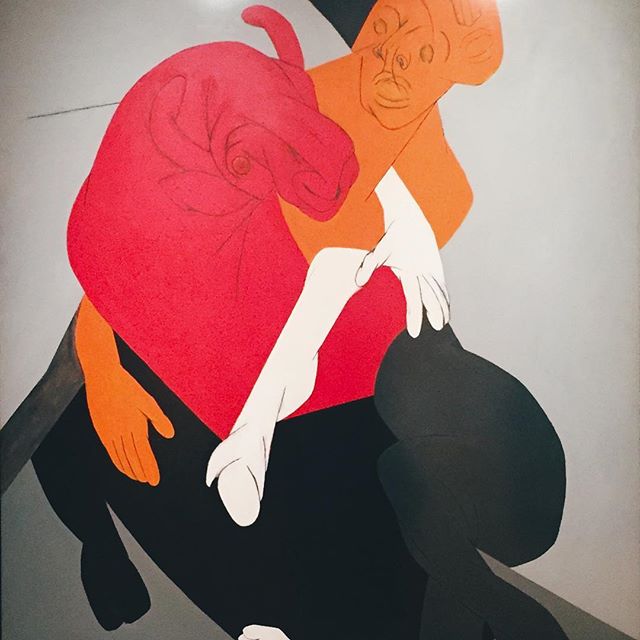
He was part of the Bombay Progressive Artists' Group and the first post-colonial generation of artists in India who broke free from the nationalist Bengal school and embraced Modernism, with its Post-Impressionist colours, cubist forms and brusque, expressionistic styles. His painting 'Celebration' set a record in 2002 as the highest sum for an Indian painting at an international auction, triggering the subsequent great Indian art boom.
- born
- 26 July 1925, Kapadvanj, Kheda district, Gujarat, India
- field
- Painting, sculpture, film making
- nationality
- Indian
- known_for
- Triptych 'Celebration', 'Diagonal Series', Santiniketan triptych series, 'Kali', 'Mahishasura' (1996)
Verified Timeline
Lore & Background
Tyeb Mehta was born on 26 July 1925 in Kapadvanj, Gujarat, and brought up in the Crawford Market neighbourhood of Mumbai, populated by Dawoodi Bohras. At age 22, during the partition riots of 1947 in Mumbai, he witnessed a man being stoned to death by a mob, an event he expressed in a drawing that had a lasting impact on his work, leading to stark and often disturbing depictions of his subjects. He initially worked as a film editor at Famous Studios in Tardeo, Mumbai, before receiving his diploma from Sir J. J. School of Art in 1952. He was part of the Bombay Progressive Artists' Group, which drew stylistic inspiration from Western Modernism and included F.N. Souza, S.H. Raza and M.F. Husain. Mehta left for London in 1959, working and living there until 1964, where his style was influenced by the expressionist works of Francis Bacon. He then visited New York City after receiving a fellowship from the John D. Rockefeller 3rd Fund in 1968, and his work there became characterised by minimalism. He made a three-minute film, 'Koodal' (Tamil for 'meeting place'), shot at the Bandra slaughter house, which won the Filmfare Critics Award in 1970. He was an Artist-in-Residence at Santiniketan between 1984–85, returning to Mumbai with significant changes in his work. Common themes included trussed bulls and the rickshaw puller, from which he moved to the 'Diagonal Series', created through the 1970s after accidentally discovering it in 1969 when he flung a black streak across his canvas. Later works included 'Falling Figures' (1991), based on his experience of witnessing the violent death during the Partition riots, and mythological figures such as goddess Kali and demon Mahishasura.
Reader's Guide
Tyeb Mehta's significance lies in his role as a pioneering modernist who helped shift Indian art from nationalist traditions to international contemporary idioms. His work, marked by stark expressionism and later minimalism, reflected personal trauma and mythological themes. In 2005, 'Gesture' sold for 31 million Indian rupees, the highest price ever paid by an Indian for a work of Indian contemporary art at auction in India at the time. Mehta's were the first works by a contemporary Indian artist to sell for over a million dollars, indicating burgeoning international interest in Indian art, and he became a cultural hero. He received several awards including the Padma Bhushan in 2007. His legacy endures as a key figure in the Bombay Progressive Artists' Group and a catalyst for the global recognition of Indian modern art.
Did You Know?
- He accidentally discovered his 'Diagonal Series' in 1969 when, in a moment of creative frustration, he flung a black streak across his canvas.
- His three-minute film 'Koodal', shot at the Bandra slaughter house, won the Filmfare Critics Award in 1970.
- Mehta witnessed a man being stoned to death during the 1947 partition riots in Mumbai, an event that had a lasting impact on his work.
A Muslim Painter in a Broader Tradition
Tyeb Mehta is identified in the available record as a Muslim painter, a designation that situates him within a specific cultural and religious artistic lineage. His name appears in a subarticle dedicated to the intersection of Muslim identity, artistic practice, and Islamic art — a subarticle that functions as an incomplete catalogue of notable painters who were or are Muslim. This framing positions Mehta not merely as a painter in isolation, but as a contributor to a tradition that spans multiple nations and decades. The very existence of such a list, gathering artists from diverse backgrounds under the shared thread of Muslim identity and the act of painting or drawing, suggests that Mehta's work is understood as part of a broader conversation about faith and visual expression. He is one name among many in this roster, yet his inclusion affirms his recognition as a figure whose artistic output is meaningfully connected to the Muslim artistic heritage that the subarticle seeks to document.
An Indian Voice in a Multinational Roster
Tyeb Mehta is recorded as an Indian painter, a national identity that anchors him within the South Asian artistic landscape while the broader list he inhabits stretches across the entire Muslim world. His countryman M. F. Husain, another Indian painter who lived from 1915 to 2011, appears in the same catalogue, creating a small cluster of Indian names within a far larger international grouping. Beyond India, the roster reaches into Palestine with Abed Abdi, into Bangladesh with Zainul Abedin, into Indonesia with Affandi and his daughter Kartika Affandi, into Turkey with İsmail Acar, into Pakistan with figures such as Shakir Ali, Abdur Rahman Chughtai, and Ismail Gulgee, and into Tunisia with Hédi Khayachi. Mehta's placement among this constellation of artists from at least a dozen different countries underscores that his recognition as a notable Muslim painter is situated within a genuinely global and multi-generational community of visual artists.
A Life Spanning Eight Decades
The record before us places Tyeb Mehta's life between 1925 and 2009, an eighty-four-year arc that stretches from the interwar period of the early twentieth century all the way into the first decade of the twenty-first. His birth year, 1925, situates him just two years after the births of fellow listed painters SM Sultan and Sadequain, both born in 1923, and a full decade after M. F. Husain's 1915 arrival. His death in 2009 coincides with that of Indonesian painter and lecturer Umi Dachlan, who also passed in that same year. Across those eight decades, Mehta's career as a painter unfolded against a backdrop of profound global change, though the specific details of his artistic journey are not elaborated in the source material at hand. What the dates do confirm is a life of considerable length and a career that, by its very span, touched multiple generations of the twentieth and early twenty-first centuries.
The Incomplete List and What It Implies
The subarticle in which Tyeb Mehta appears is explicitly described as an incomplete list of notable Muslim painters. This qualifier — incomplete — is significant. It acknowledges that the roster, while gathering names from Palestine, Bangladesh, Indonesia, Turkey, Pakistan, Tunisia, and India, does not claim to be exhaustive. Mehta's presence in a list that admits its own gaps suggests that his recognition as a notable Muslim painter is established enough to warrant inclusion, yet the broader field of Muslim artists engaged in painting and drawing extends well beyond what is catalogued here. The subarticle also notes that a Muslim painter is defined as a Muslim who is or was engaged in painting or drawing, a definition broad enough to encompass the full range of visual practice. Mehta, as an Indian painter within this framework, is one thread in a tapestry that the list aspires to represent but necessarily cannot fully capture.
Gallery
Frequently Asked Questions
What is Tyeb Mehta's most famous work?
His triptych 'Celebration' is widely regarded as his signature piece. In 2002 it became the highest-priced Indian painting sold at an international auction, a milestone that helped ignite the broader Indian art market boom.
Which art movement or group was Tyeb Mehta part of?
He was a key member of the Bombay Progressive Artists' Group, the first post-colonial generation of Indian artists to move past the Bengal nationalist school. His work embraced Modernist techniques—cubist structure, Post-Impressionist colour, and raw expressionistic brushwork.
What other media did Tyeb Mehta work in besides painting?
Alongside his canvases, Mehta created sculptures and made films. His painting output also spans notable series such as the Diagonal Series and the Santiniketan triptychs, as well as iconic single images like 'Kali' and 'Mahishasura' (1996).
Why is Tyeb Mehta considered important to Indian art history?
He helped define a modernist visual language for post-independence India, breaking free from earlier nationalist conventions. His record-breaking 2002 auction sale of 'Celebration' is often cited as the moment that put Indian contemporary art on the global stage.
More in Painters & Visual Artists 1-23
Spotted an error? Know more?
This is a living reference — every entry is fact-audited, and reader corrections feed straight into our audit queue. Suggest an edit · See this site's audit record