
Umberto Boccioni
Italian painter and sculptor; key theorist of Futurism.

via Wikipedia: Umberto Boccioni · see source
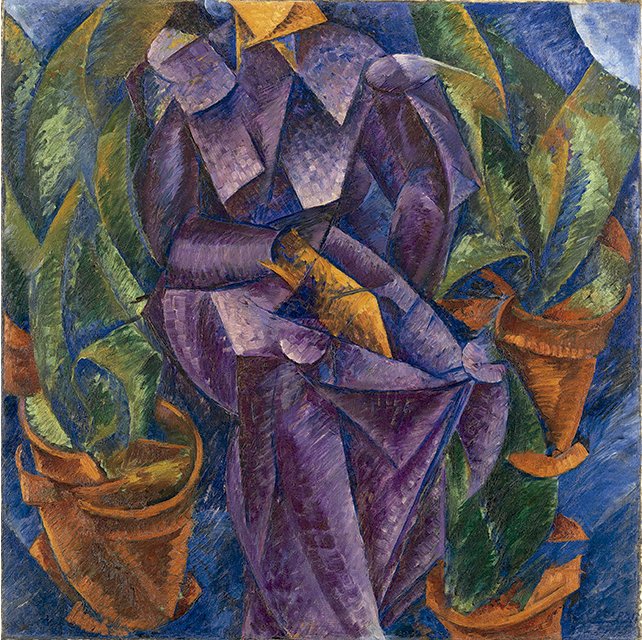
Umberto Boccioni (19 October 1882 – 17 August 1916) was an influential Italian painter and sculptor. He helped shape the revolutionary aesthetic of the Futurism movement as one of its principal figures. Despite his short life, his approach to the dynamism of form and the deconstruction of solid mass guided artists long after his death. His works are held by many public art museums, and in 1988 the Metropolitan Museum of Art in New York City organized a major retrospective of 100 pieces.
- born
- 19 October 1882, Reggio Calabria, Italy
- died
- 17 August 1916, Verona, Italy
- field
- Painting, sculpture
- nationality
- Italian
- known_for
- Principal figure of Futurism; dynamism of form and deconstruction of solid mass
Verified Timeline
Lore & Background
Umberto Boccioni was born on 19 October 1882 in Reggio Calabria. His father was a minor government employee whose job included frequent reassignments, so the family relocated to Forlì, Genoa, and finally Padua. At age 15, in 1897, Umberto and his father moved to Catania, Sicily, where he finished school. After 1898 he moved to Rome and studied art at the Scuola Libera del Nudo of the Accademia di Belle Arti di Roma, also studying under Liberty style poster artist Giovanni Mataloni. In Rome he met Gino Severini in 1901; both became students of Giacomo Balla, learning the modern Divisionist technique. Boccioni briefly moved to Paris in 1906, studying Impressionist and Post-Impressionist styles, then visited Russia for three months, witnessing civil unrest and governmental crackdowns. Returning to Italy in 1907, he took drawing classes at the Accademia di Belle Arti of Venice. He moved to Milan in 1907, met Divisionist painter Gaetano Previati in early 1908, and met Filippo Tommaso Marinetti in early 1910. On 11 February 1910 Boccioni, with Balla, Carlo Carrà, Luigi Russolo, and Severini, signed the Manifesto dei pittori futuristi, and on 8 March he read the manifesto at the Politeama Chiarella theatre in Turin.
Reader's Guide
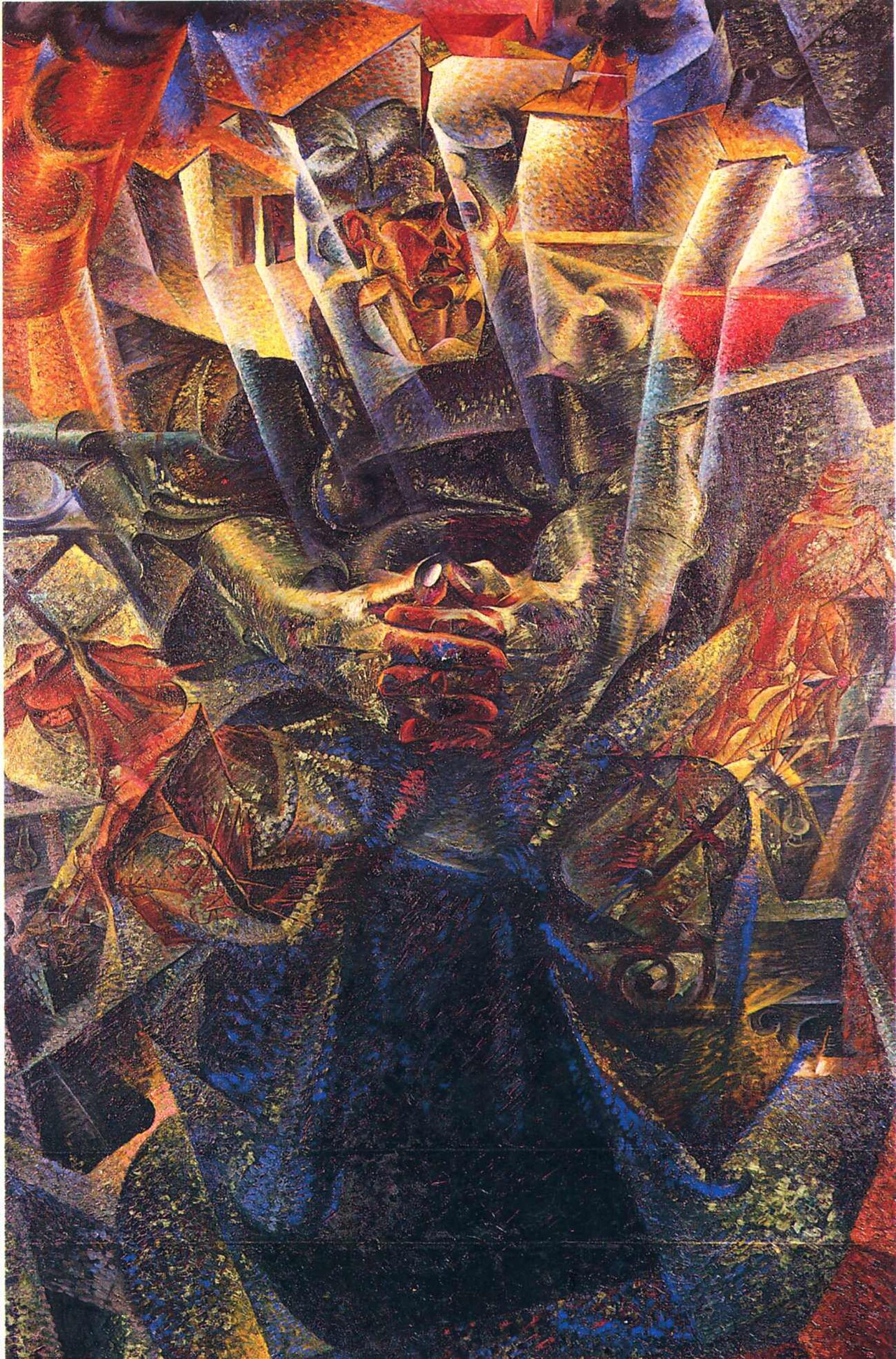
Boccioni became the main theorist of the Futurism movement. He worked for nearly a year on 'La città sale' (1910), a huge 2m by 3m painting considered his turning point into Futurism. In 1911 he spent much of the year on a trilogy titled 'Stati d'animo' — 'The Farewells', 'Those Who Go', and 'Those Who Stay' — and completed 'La risata', his first truly Futurist work. After traveling to Paris toward the end of 1911 and seeing what Braque and Picasso had been doing, the movement began to take real shape. In 1912 he decided to become a sculptor after visiting studios in Paris including those of Georges Braque, Alexander Archipenko, Constantin Brâncuși, Raymond Duchamp-Villon, August Agero, and probably Medardo Rosso. He exhibited paintings at Galerie Bernheim-Jeune in 1912 and sculptures at Galerie La Boétie in 1913. In 1914 he published 'Pittura e scultura futuriste (dinamismo plastico)', explaining the group's aesthetic: 'While the impressionists paint a picture to give one particular moment... we synthesize every moment (time, place, form, color-tone) and thus paint the picture.' He exhibited in London with the group in 1912 and 1914. Boccioni was drafted into the Italian Army in May 1916; on 16 August 1916 he was thrown from his horse during a cavalry training exercise and trampled, dying the following day at age thirty-three.
Did You Know?
- Boccioni's father was a minor government employee originally from the Romagna region, and his job involved frequent reassignments throughout Italy.
- Boccioni and Gino Severini became students of Giacomo Balla, who taught the modern Divisionist technique of painting with divided rather than mixed color.
- In 1910 Boccioni signed the Manifesto dei pittori futuristi on 11 February and read it publicly at the Politeama Chiarella theatre in Turin on 8 March.
- Boccioni's painting 'La città rise' (1910) was sold to pianist Ferruccio Busoni for 4,000 lire and is now frequently on display at the Museum of Modern Art in New York.
- Boccioni died at age 33 after being thrown from his horse during a cavalry training exercise on 16 August 1916 and was buried in the Monumental Cemetery of Verona.
Artistic Formation and Intellectual Roots
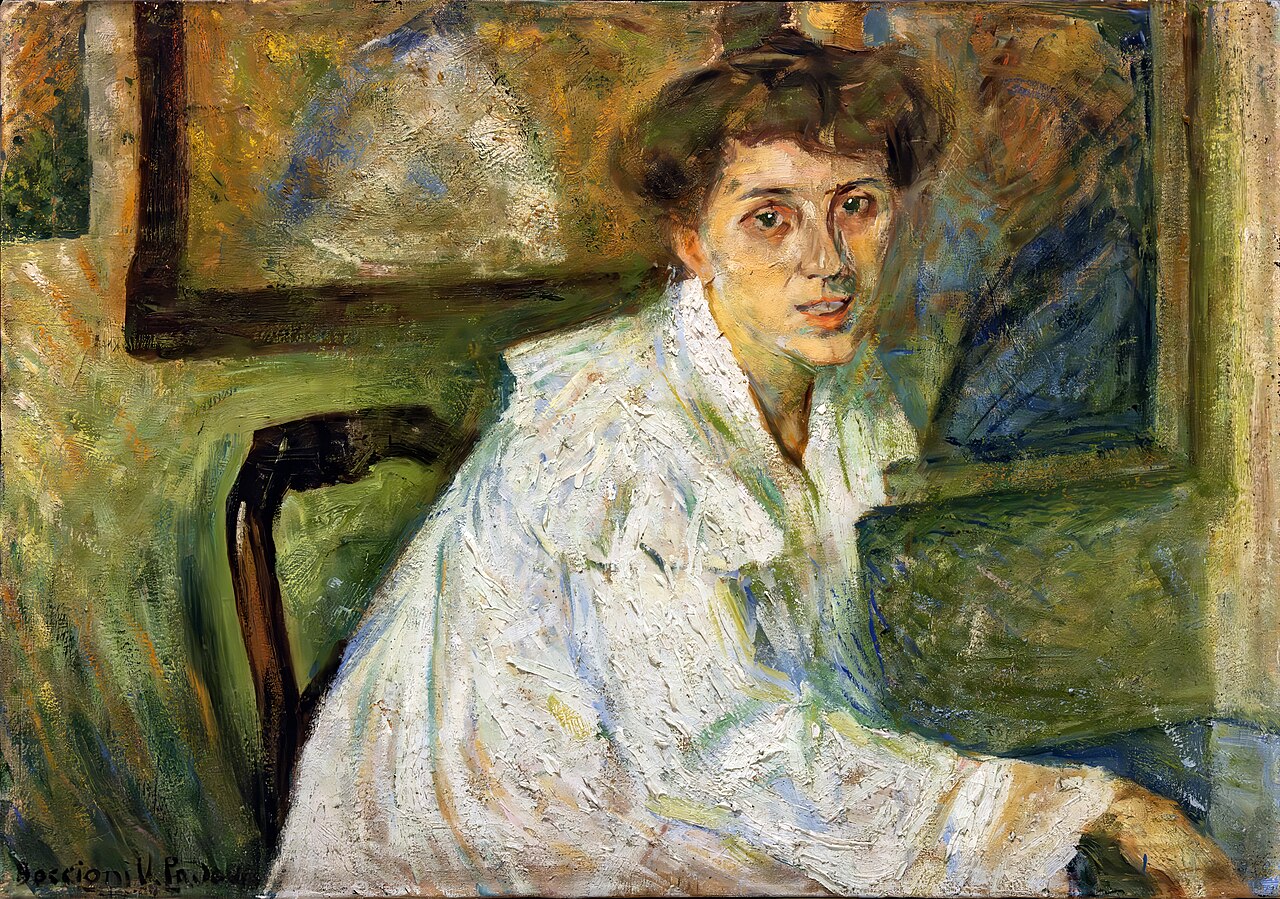
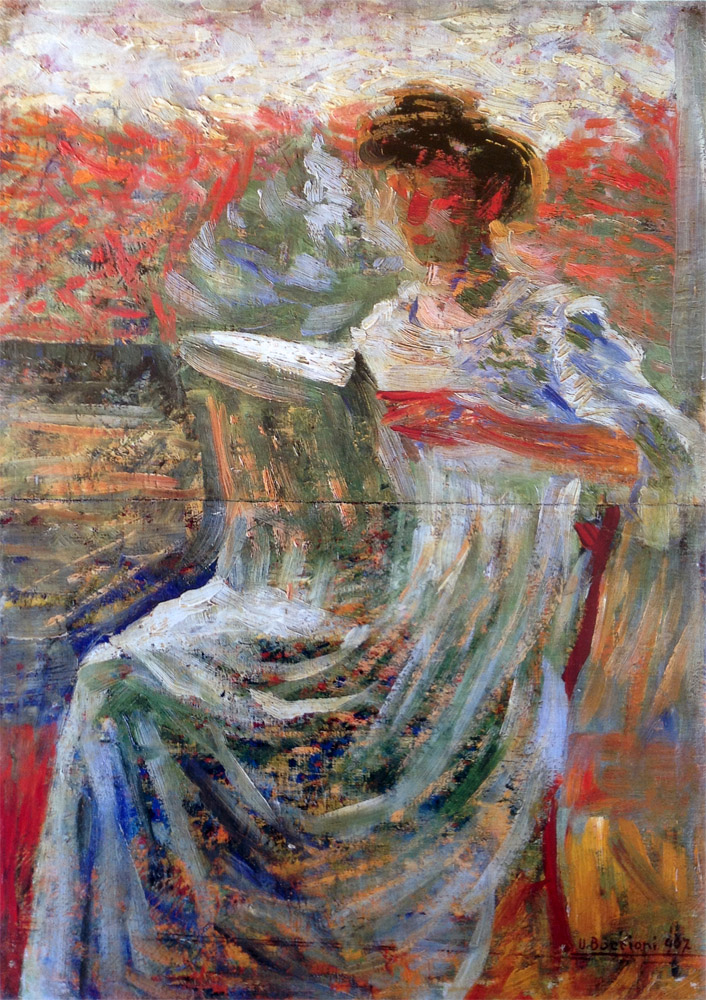
Umberto Boccioni was born on 19 October 1882 in Reggio Calabria to a minor government clerk whose frequent reassignments kept the family in constant motion. He and his older sister Amelia grew up in Forlì, Genoa, and Padua before the family settled in Catania, Sicily, where he finished school at fifteen. Around 1898 he relocated to Rome to study at the Scuola Libera del Nudo of the Accademia di Belle Arti, also training under the Liberty-style poster artist Giovanni Mataloni. His Roman years were defined by a close friendship with Gino Severini, whom he met in 1901. The two shared interests in Nietzsche, socialism, and a restless appetite for rebellion, traits that would later color Boccioni's writing with a signature blend of outrage and irony. After building a technical foundation through the Impressionist tradition, both became students of Giacomo Balla, whose Divisionist technique of fragmenting color into stippled dots and stripes proved transformative for their development. A brief stay in Paris in 1906 introduced Boccioni to Impressionist and Post-Impressionist painting, while a three-month trip to Russia offered a stark, firsthand encounter with civil unrest and governmental crackdowns.
Futurism and Theoretical Leadership
After settling in Milan in 1907, Boccioni's path converged with the revolutionary currents that would define his legacy. In early 1910 he met Filippo Tommaso Marinetti, who had published his Manifesto del Futurismo the previous year. On 11 February 1910, Boccioni joined Balla, Carlo Carrà, Luigi Russolo, and Severini in signing the Manifesto dei pittori futuristi, then delivered it at the Politeama Chiarella theatre in Turin on 8 March. He rapidly emerged as the movement's principal theorist. A pivotal moment arrived toward the end of 1911, when Boccioni, Balla, Severini, and a few other Futurists traveled to Paris and encountered the work of Braque and Picasso; the movement began to take real shape only after that encounter. In 1912 he visited the studios of Cubist sculptors including Brâncuși, Duchamp-Villon, and Archipenko, experiences that led him to take up sculpture. He exhibited paintings at the Galerie Bernheim-Jeune that year and returned the following year to show his sculptures at the Galerie La Boétie. In 1914 he published Pittura e scultura futuriste (dinamismo plastico), articulating the group's core aesthetic: where Impressionists captured a single moment, Futurists synthesized every moment—time, place, form, and color-tone—into a unified picture.
Commercial Work and International Exhibitions
Between his most ambitious artistic experiments, Boccioni sustained himself as a commercial illustrator, a role that sharpened his awareness of broader European visual trends. From 1904 to 1909 he produced lithographs and gouache paintings for internationally recognized publishing houses, including the Berlin-based Stiefbold & Co. His commercial output reveals a keen familiarity with the work of contemporary illustrators such as Cecil Aldin, Harry Eliott, Henri Cassiers, and Albert Beerts, demonstrating that his avant-garde ambitions coexisted with a practical command of the visual language circulating across Europe. His reach extended well beyond Italy through group exhibitions. In 1912 he showed alongside other Italian Futurists at the Sackville Gallery in London, and in 1914 the group returned to the Doré Gallery. Both London shows made a deep impression on young English artists. C.R.W. Nevinson, in particular, was so moved that he joined the Futurist orbit, while others gravitated toward the British equivalent, Vorticism, under Wyndham Lewis. Boccioni's works are now held in numerous public art museums worldwide, and in 1988 the Metropolitan Museum of Art in New York organized a major retrospective gathering one hundred pieces, a testament to the enduring reach of a career spanning barely a decade.
Military Service and Tragic End
Italy's entry into the First World War in late May 1915, declared against the Austro-Hungarian Empire, drew Boccioni into military service. He joined the Lombard Battalion Volunteers Cyclists and Motorists, which departed Milan in early June for Gallarate and then Peschiera del Garda, positioned in the rear of the Trentino front. In July 1915 the volunteers were slated for a sector around Ala and the Gardesana. On 24 October 1915, Boccioni took part in the battle of Dosso Casina. By 1 December the battalion was dissolved as part of a broader reorganization; the volunteers were temporarily laid off before each was called up with his class. In May 1916 Boccioni was formally drafted into the Italian Army and assigned to an artillery regiment at Sorte of Chievo, near Verona. His life ended abruptly on 16 August 1916, when he was thrown from his horse during a cavalry training exercise and trampled. He died the following day at Verona Military Hospital, aged just thirty-three. His approach to the dynamism of form and the deconstruction of solid mass, forged in barely a decade of intense creative work, would continue to guide artists long after his death.
Gallery
Frequently Asked Questions
Who is Umberto Boccioni?
Umberto Boccioni was an Italian painter and sculptor born in Reggio Calabria in 1882. He is best remembered as one of the leading creative forces behind the Futurist movement in early 20th-century Italy.
What was Umberto Boccioni's role in Futurism?
Boccioni served as a principal figure and key theorist of Futurism, helping to define the movement's revolutionary visual language. His writings and works pushed the group toward depicting movement and energy rather than static subjects.
What made Umberto Boccioni's artistic style distinctive?
He focused on capturing the dynamism of form and breaking apart the idea of solid, fixed mass in his paintings and sculptures. This approach to representing motion and fragmentation set his work apart from more traditional Italian art of the period.
When and where did Umberto Boccioni die?
Boccioni died on 17 August 1916 in Verona, Italy, at the age of thirty-three. His life was cut short during World War I, leaving behind a remarkably compact but influential body of work.
Why is Umberto Boccioni still important to art history?
Despite his brief career, his ideas about dynamism and the deconstruction of solid form continued to influence artists well beyond his death. He remains a foundational reference point for understanding how modernist painters and sculptors reimagined the representation of movement and space.
More in Painters & Visual Artists 1-23
Spotted an error? Know more?
This is a living reference — every entry is fact-audited, and reader corrections feed straight into our audit queue. Suggest an edit · See this site's audit record